Burlingame vs. Other Peninsula Cities
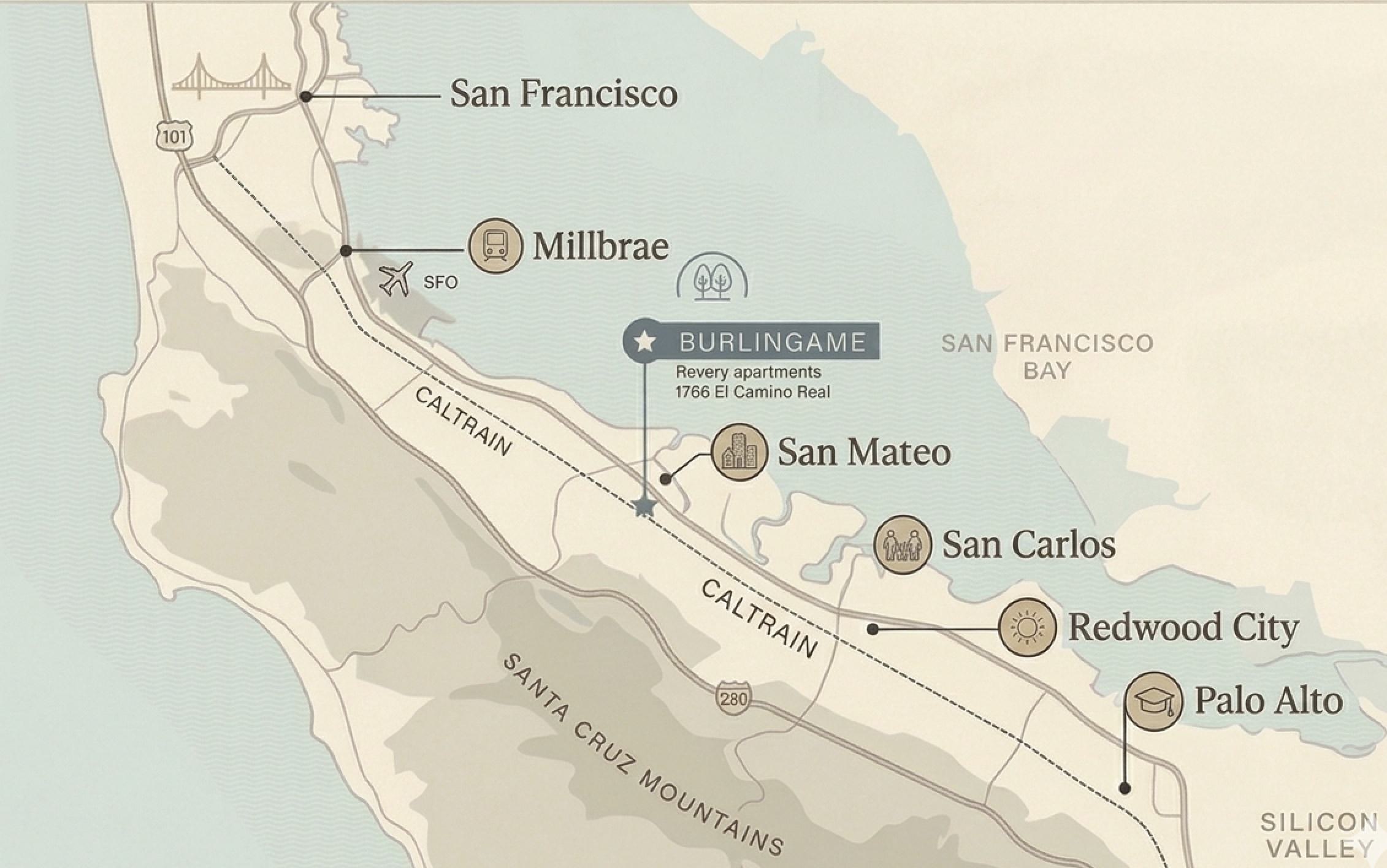
Burlingame: Find Your Sweet Spot
Nicknamed the “City of Trees,” Burlingame pairs walkable 'village charm with a wonderful array of upscale boutiques and dining destinations, all without the high-density footprint of its larger neighbors.
- The Vibe: Boutique and polished. You get the upscale retail and dining of a larger city (like Palo Alto) but paired with the quiet, canopy-lined streets of a residential suburb.
- Walk Score: 77 (Citywide). The downtown cores—Burlingame Avenue and Broadway—are a 96+ "Walker’s Paradise."
- Known For: Its two separate downtown districts (a rare find), the massive historic Eucalyptus groves, and its central location that keeps you exactly 20 minutes from almost everywhere.
- Best for: People who want high-end amenities (like Revery) within a five-minute walk of a refined social scene, plus frequent travelers who need elite access to SFO.
- SF Commute: ~20 mins (Car); ~30 mins (Caltrain). It is one of the closest "suburban" feel cities to San Francisco.
- Microclimate: Mild & Coastal. It’s the "Goldilocks" zone—cooler and breezier than the South Bay, but significantly sunnier than San Francisco or Daly City.
Burlingame vs. San Francisco
The Difference: The ultimate "Urban vs. Suburban" showdown. While Burlingame offers a curated, "best-of" version of city life in a manicured package, San Francisco provides the unfiltered energy, diverse micro-neighborhoods, and world-class cultural scale that only a major global metropolis can offer.
San Francisco Overview:
- The Vibe: High-energy and eclectic. SF is a patchwork of distinct personalities—from the tech-forward glitter of Hayes Valley to the historic fog-swept charm of Richmond. It trades Burlingame's quiet canopy for "Big City" density, skyline views, and a 24/7 pulse.
- Walk Score: 89 (Citywide). Most central neighborhoods hit a perfect 100. One of the few places in the Bay Area where a car is truly optional (and often a liability).
- Known For: Iconic landmarks (Golden Gate Bridge, Alcatraz), a world-renowned culinary scene, professional sports, and being the financial and technological heart of the West Coast.
- Best for: Young professionals, culture seekers, and "urbanites" who prioritize proximity to nightlife, museums, and career hubs.
- Microclimate: Dynamic & Foggy. Famous for "Karl the Fog," SF is significantly cooler and more unpredictable than Burlingame. You can experience a 10-degree difference just by crossing from the sunny Mission District to the misty Sunset District.
Burlingame vs. Millbrae
The Difference: Millbrae is the transit powerhouse. While they share a border and a similar suburban feel, Millbrae trades some of Burlingame’s historic "trees and teas" charm for unparalleled regional connectivity and a more practical vibe.
Millbrae Overview:
- The Vibe: Suburban and functional. It feels a bit more "built for the commute" than Burlingame. Quiet, safe, and family-oriented, with a downtown (Broadway) that offers a fantastic, no-frills selection of authentic Asian cuisine.
- Walk Score: 41 (Citywide). While the Broadway core is a "Walker’s Paradise," the city’s residential layout is dominated by hills, making a car necessary for residents living west of El Camino Real.
- Known For: The Millbrae Intermodal Station—the only place in the Bay Area where BART and Caltrain meet in one spot. Also famous for its annual Art & Wine Festival and its high-performing public schools.
- Best for: Super-commuters who need to get to both San Francisco and the East Bay or South Bay regularly, and families looking for a slightly more "attainable" price point than Burlingame without sacrificing school quality.
- SF Commute: ~15–20 mins (Car); ~22 mins (Caltrain); ~35 mins (BART). Milbrae is the most convenient jumping-off point for the entire Bay Area.
- Microclimate: Mild & Transitionary. It sits right in the path of the "San Bruno Gap," meaning it gets a bit more wind and fog than Burlingame, but stays warmer and drier than San Francisco.
Burlingame vs. San Mateo
The Difference: San Mateo is the Peninsula's true urban heart. It provides a much larger, more diverse city footprint with a sprawling downtown and a wide variety of housing. It trades Burlingame's quiet "village" atmosphere for the energy and amenities of a self-sustaining regional hub.
San Mateo Overview:
- The Vibe: Diverse and energetic. It blends an urban downtown energy with quiet, leafy neighborhoods like San Mateo Park. It feels more "lived-in" and inclusive than Burlingame, offering a broader range of price points.
- Walk Score: 65 (Citywide). The Downtown core and the Bay Meadows development are "Walker’s Paradises" (93+), but because the city is so large, the western hills and bayside residential tracts are significantly more car-dependent.
- Known For: Its massive, multi-block Downtown district (one of the largest on the Peninsula), Central Park’s Japanese Tea Garden, and being the culinary capital of the region—specifically for its world-class Japanese cuisine and Michelin-rated spots.
- Best for: Foodies, young professionals, and urbanites who want "big city" amenities without the intensity of San Francisco. It’s also the perfect "pivot point" for those who frequently cross the San Mateo-Hayward Bridge to the East Bay.
- SF Commute: ~25–30 mins (Car); ~30–40 mins (Caltrain). With three distinct Caltrain stations (San Mateo, Hayward Park, and Hillsdale), it offers more transit flexibility than almost any other city on the line.
- Microclimate: Sunny & Balanced. San Mateo is generally warmer and sunnier than its northern neighbors. It is largely protected from the "San Bruno Gap" winds, making it the "warm-weather" alternative to Burlingame.
Burlingame vs. San Carlos
The Difference: While both cities offer a high-end, community-focused lifestyle, San Carlos is often seen as the more "laid-back, family-centric" sibling, whereas Burlingame leans into a more "polished, upscale boutique" energy.
San Carlos Overview:
- The Vibe: Small-town charm with a "Mayberry" feel. The downtown core (Laurel Street) is packed with independent, family-owned restaurants and local hardware stores rather than big-name retailers.
- Walk Score: 47 (Citywide), though the Downtown/Laurel Street area hits a "Walker’s Paradise" score of 93.
- Known For: Its "City of Good Living" motto, hilly residential views, older single-family homes, and the Hiller Aviation Museum.
- Best for: Families who want a quieter evening scene and those who prefer hiking in the western hills over a bayfront stroll.
- SF Commute: ~40–50 minutes by Caltrain; ~35–45 minutes by car (depending on traffic).
- Microclimate: Sunnier and warmer than its northern neighbors. It’s tucked far enough south to escape the heavy fog, often running 5–8 degrees warmer than Burlingame.
Burlingame vs. Palo Alto
The Difference: Palo Alto operates on a global stage as the intellectual and venture capital heart of Silicon Valley. Choosing between them is often a choice between Burlingame’s "accessible luxury" and central Peninsula location versus Palo Alto’s world-renowned academic prestige and deep-rooted tech-titan energy.
Palo Alto Overview:
- The Vibe: Academic meets high-stakes. It’s a mix of historic, professor-filled neighborhoods and ultra-high-net-worth innovation hubs. Sophisticated and intellectual, fueled by its proximity to Stanford University and the venture capital firms of Sand Hill Road.
- Walk Score: 58 (Citywide). The neighborhoods flanking University Avenue (North & South) and California Avenue are a "Walker’s Paradise" (85–90+), but the city's expansive footprint and the split created by Oregon Expressway make the southern half more car-reliant.
- Known For: Stanford University, being the "Birthplace of Silicon Valley," and its unparalleled public school system. Also famous for its distinct architectural pockets—ranging from the Eichlers of south Palo Alto to the grand estates of Old Palo Alto and Crescent Park.
- Best for: Tech executives, academics, and those who want to be at the epicenter of the global innovation economy. It’s the top choice for buyers where "school district rank" and "proximity to Stanford" are high priorities.
- SF Commute: ~45–55 mins (Car); ~40–50 mins (Caltrain Express). While further from SF than Burlingame, it serves as its own gravity-well, with many residents rarely needing to leave the city limits for work or high-end dining.
- Microclimate: Warm & Sunny. Palo Alto is consistently warmer than Burlingame. Protected by the Santa Cruz Mountains, it skips the coastal fog almost entirely, offering a true "California summer" feel with significantly more heat during July and August.
Which is best for you?
- Choose San Francisco if you prioritize high-density urban living and a car-free lifestyle. Immediate access to diverse micro-neighborhoods, major museums, and a 24/7 culinary scene.
- Choose Burlingame if you want walkable, high-end retail and dining within a quiet, canopy-lined residential setting. It offers a polished "village" feel with the shortest commute to both SFO and San Francisco.
- Choose San Carlos if you prefer a sunnier, family-centric atmosphere with a "small-town" downtown. It’s ideal for those seeking hilly residential views and a community vibe centered around local, independent businesses.
- Choose Millbrae if regional connectivity is your top priority. It is the only city where BART and Caltrain meet at one station, making it the most efficient hub for multi-directional commuters who still want a quiet, suburban home base.
- Choose San Mateo if you want a diverse, mid-sized city with a sprawling downtown district. It offers a wider range of housing types and price points, acting as a central pivot point for both Peninsula and East Bay access.
- Choose Palo Alto if you want proximity to Stanford and the venture capital hub of Silicon Valley. It’s for those who prioritize top-tier academic prestige and a warmer Mediterranean climate over central Peninsula proximity.
A New Revery
Brand-new luxury apartments at Revery in Burlingame blend sustainable modern design with expansive windows, spacious floor plans, and a fantasic suite of lifestyle and wellness-focused amenities.